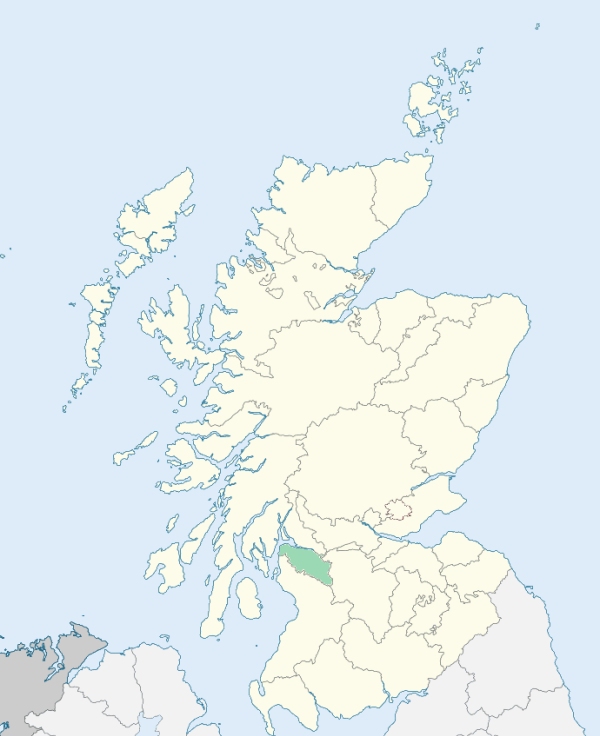
Cathcart is a parish partly in Lanarkshire, but chiefly in Renfrewshire, and reaching within a mile of the southern suburbs of Glasgow. It is bounded by the parishes of Govan, Gorbals, Rutherglen, Carmunnock, Mearns, and Eastwood. (1867: The Imperial Gazetteer of Scotland, by John Marius Wilson).
Clarkston, Crosshill, Crossmyloof, Hanginghsaw, Langside, Millbridge, Netherlee, New Cathcart, Old Cathcart
Camphill, Linn
(1) The parish of Cathcart was situated partly in the county of Renfrew and partly in the county of Lanark. The Lanarkshire portion was divided into two, one being a detached part of the parish and the other forming part of the main portion of the parish. The detached part of the parish was transferred to the parish of East Kilbride, thus remaining in Lanarkshire. The remainder of the parish of Cathcart was placed wholly in the county of Renfrew. See affected properties and landholders. (1892: Boundary of counties and parishes in Scotland as settled by the Boundary Commissioners under the Local Government Act, 1889, by Hay Shennan)
(2) The city of Glasgow, as defined by the City of Glasgow Act, 1891, is partly in Lanarkshire and partly in Renfrewshire. Clause III proposes to put the whole of the extended city in the county of Lanark. The subjects so to be transferred are far too numerous to detail. They are situated partly in the:
Parish of Govan - Polmadei, Strathbungo, Pollokshields, Pollokshields East
Parish of Cathcart - Crosshill, Crossmyloof, Langside, Mount Florida
Parish of Eastwood - Shawlands
The effect of the change just described would be to place the parish of Govan wholly in Lanarkshire, with the exception of the police burgh of Kinning Park, which would remain in Renfrewshire. See affected properties and landholders. (1892: Boundary of counties and parishes in Scotland as settled by the Boundary Commissioners under the Local Government Act, 1889, by Hay Shennan)
PRE-REFORMATION GOVERNANCE:
POST-REFORMATION GOVERNANCE:
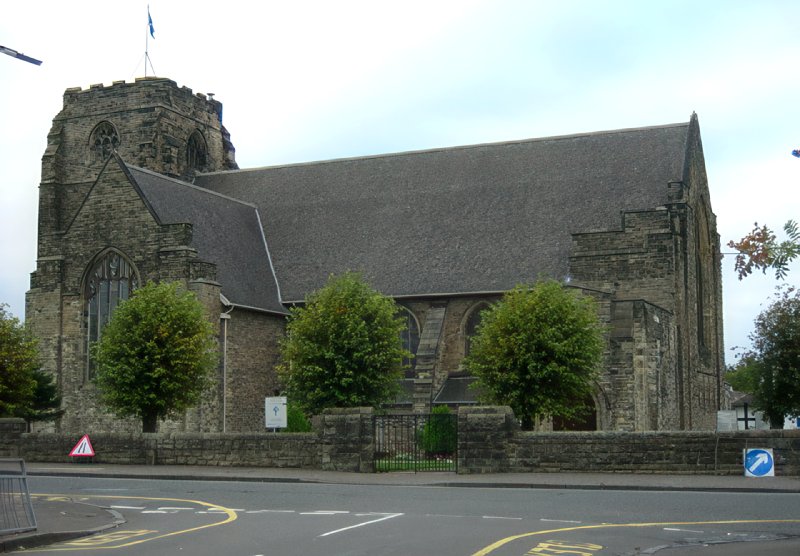
The parish church, which belonged to the Abbey of Paisley, was dedicated to St Oswald, and beside it was St Oswald's Well. In March 1595, the parish of Cathcart was taken by the General Assembly out of the Presbytery of Paisley and added to that of Glasgow.
Disjoined Quoad Sacra Parishes:
Battlefield. In June 1902 religious services were begun here in an iron building. This was replaced in May 1909 by a stone church. The parish of Battlefield was disjoined from Cathcart on 19 June 1912.
Greenbank. A church was built here in 1885. The parish was disjoined from Cathcart, Eastwood, and Mearns by the Court of Teinds, 25 February 1889.
Langside. In 1876 religious services were begun here in a temporary building in Seyton Avenue. A church was built in 1886. The parish of Langside was disjoined from Cathcart on 8 November 1901.
Merrylea. Services were begun here in an iron building on 4 October 1903. A stone church was opened on 11 September 1915. The parish was disjoined from Cathcart, 15 March 1918.
Queen's Park. Mission work was begun here in 1869. A church was built in 1873. Queen's Park was disjoined from Cathcart and Govan on 1 March 1875.
Includes ministers, licentiates, assistants, readers, and clerks.
Cathcart (QO)
Battlefield (QS)
Greenbank (QS)
Langside (QS)
Merrylea (QS)
Queen's Park (QS)
(1928: Fasti Ecclesiæ Scoticanæ, by Hew Scott, D. D.)
Parish registers turned over to the Registrar-General, as a result of the Registration of Births, Deaths, and Marriages (Scotland) Act of 1854. The letters B. D. and M. indicate Births (or Baptisms), Deaths (or Burials), and Marriages (or Proclamations of Banns) respectively. Numbers indicate separate volumes or books. Note: These records are by no means complete or without damage; consult the Detailed List of the Old Parochial Registers of Scotland (1872) to learn more about the condition of the records.
| OPR and RD Numbers | |||
|---|---|---|---|
| Date Range | Name | Number | Type |
| 1690-1854 | Cathcart | 560 | OPR |
| 1855-1912 | Cathcart | 560 | RD |
| 2009 | Cathcart, Glasgow City | 601-624 | RD |
| 2026 | Glasgow City Council; Cathcart, Merrylee and Muirend Community Council | ||
(2009: Parishes and Registration Districts of Scotland - Old and New, National Records of Scotland)
Local community councils (2026) are provided as a potential source of additional information for settlements within the original boundaries of the parish. (Source)
Statistics from informal and official censuses
Allan, Anderson, Brown, Campbell, Robertson, Smith, Stewart, Thomson, Watson, Wilson
Note: Names appearing in research materials, other than censuses. Simple names (First name, surname only) have been omitted unless they appear associated with large properties. All women's names, and men's names with occupations, military ranks, or peerage titles are included.
By the Reverend Mr David Dow.
"The population in 1791 was 697, of whom 370 were males and 327 were females. There were 139 families, 81 of which belonged to the Established Church, and 58 Seceders of various denominations. There are 29 farmers, 10 weavers, 3 masons and wrights, 3 smiths, 5 paper makers, 2 millers, 4 shoemakers, 2 tailors, 20 lime quarriers, and 35 day labourers. There is neither butcher, brewer, nor baker within its bounds. Besides the above, there are in the lands of Dripps, which anciently were included in this parish, 12 families, consisting of 73 persons, all of whom are employed in cultivating the ground.
This parish may be considered almost entirely as an agricultural district. While the manufactures, of Paisley and Glasgow, have diffused themselves through all the neighbouring parishes, to a much greater distance, they have as yet made but inconsiderable progress in Cathcart.
The manners and character of the people here, as well as in all other parishes, are various. It would be doing injustice to many individuals of every station, not to make many favourable exceptions; but, at the same time, it must be acknowledged, that the neighbourhood of so great a city as Glasgow, has, perhaps, unavoidably, had a very pernicious influence on the morals of the inhabitants. The frequency of their communication, with that town, has extended their knowledge, at the expence of their virtue; and they have acquired a taste for many of those vices, which flourish luxuriantly in so rank a soil. Thus, there is reason to lament the decline of that primitive innocence, and simplicity of manners and character, by which people, living in more remote situations of the country, are happily distinguished."
(This section contains excerpts, at times restructured or paraphrased, from an article appearing in Statistical Account of Scotland, Sir John Sinclair, 1791-1799)
Primary Sources:
Statistical Account of Scotland (1791-1799), Volume 5, p. 336
New Statistical Account of Scotland (1834-1845), Volume 7, Section I, p. 495
See Parish Page Sources for all source information and links.