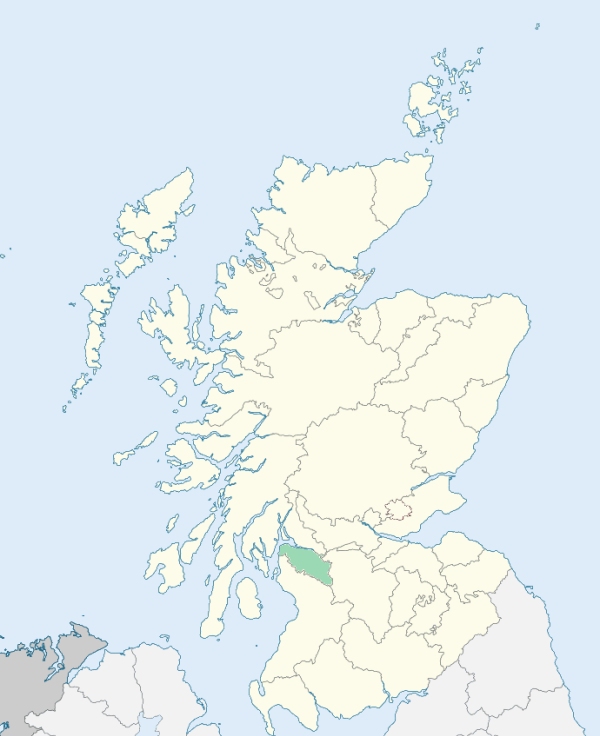
Paisley is a parish near the centre of the upper ward of Renfrewshire. It is bounded by the parishes of Renfrew, Govan, Eastwood, Neilston, Lochwinnoch, and Kilbarchan. (1867: The Imperial Gazetteer of Scotland, by John Marius Wilson).
Crossmill, Dovecothall, Elderslie, Hurlet, Johnstone, Overton, Millerston, Nitshill, Paisley, Quarrelton, Thorn
Ferguslie House
The parish of Paisley had a detached part separated from the main portion of the parish by a narrow strip of Abbey parish. Again, within this detached part of the parish of Paisley was a detached part of Abbey parish. The detached part of Paisley parish was united to the main portion of Paisley parish by the annexation to it of the small portion of Abbey parish at the River Cart, and the detached part of Abbey parish was then transferred to the Paisley parish. See affected properties and landholders. (1892: Boundary of counties and parishes in Scotland as settled by the Boundary Commissioners under the Local Government Act, 1889, by Hay Shennan)
PRE-REFORMATION GOVERNANCE:
POST-REFORMATION GOVERNANCE:
High Kirk Parish. A church was built here in 1756. Being placed upon rising ground, it was styled the High Church, in contrast to the older Laigh Kirk. The High Kirk parish was disjoined from that of the Abbey of Paisley on 20 February 1782.
St George's, or Laigh Kirk Parish. A church built here in 1736 was called, from its situation, the Laigh Kirk. On 7 July 1738, the Laigh Kirk Parish was disjoined from the parish of the Abbey of Paisley. In 1819 another church was built for this parish on a new site. It was named St George's Church, and since its erection, the Laigh Kirk Parish has been known also as St George's.
Middle Parish. A church built here was opened on 13 November 1781. The Middle Parish was disjoined from Abbey Parish on 20 February 1782.
Disjoined Quoad Sacra Parishes:
Johnstone. A church built here in 1792, was greatly renovated in 1877. On 31 May 1834 a chapel constitution was granted to the charge. The parish was disjoined from that of Paisley by decree of the Court of Teinds, 1 March 1865.
St Andrew's, Johnstone. A chapel for the district of Laighcartside was built here in 1886. St Andrew's Parish was disjoined from Johnstone, Kilbarchan, and Elderslie, on 1 November 1901.
The Martyrs' Parish. A church opened here 20 November 1835, was named in honour of the martyrs of Paisley. These two men, James Algie and John Park, were tenant farmers in the parish of Eastwood. On 3 February 1685 they were brought before the Royal Commissioners met in the town, and were charged with disowning the supremacy of King Charles in Church and State. The Court required them to take the Oath of Abjuration and the Test, warning them that refusal to do so would be fatal. Declining to comply, they were condemned, and were hanged that afternoon. A chapel constitution was granted for the district on 30 May 1836. The parish of the Martyrs was disjoined from the High Kirk and Abbey Parish of Paisley on 6 July 1874.
North Parish. A church was opened here 29 August 1834. On 1 June of that year the General Assembly granted a Chapel Constitution to the district. The North Parish was disjoined from the Middle Parish of Paisley by the Court of Teinds, 9 March 1874. In 1888 the church was rebuilt.
St Columba's Gaelic Parish. The church was erected by public subscription in 1793. On 31 May 1834 the General Assembly granted a chapel constitution to the district. The parish was disjoined from the High Church and erected as a Gaelic charge by the Court of Teinds, 6 July 1874.
South Parish. A church was opened 29 April 1836. On 30 May of that year the General Assembly granted to the district a chapel constitution. The parish was disjoined from the Laigh Kirk and the Abbey Parish of Paisley by the Court of Teinds, 18 February 1878.
Includes ministers, licentiates, assistants, readers, and clerks.
High Kirk Parish (QO)
Low Kirk, Laigh Kirk, or St George's (QO)
Middle Kirk (QO)
Johnstone (QS)
St Andrew's (QS)
Martyrs' Parish (QO)
North Parish (QO)
St Columba's Gaelic Parish (QS)
South Parish (QS)
(1928: Fasti Ecclesiæ Scoticanæ, by Hew Scott, D. D.)
Parish registers turned over to the Registrar-General, as a result of the Registration of Births, Deaths, and Marriages (Scotland) Act of 1854. The letters B. D. and M. indicate Births (or Baptisms), Deaths (or Burials), and Marriages (or Proclamations of Banns) respectively. Numbers indicate separate volumes or books. Note: These records are by no means complete or without damage; consult the Detailed List of the Old Parochial Registers of Scotland (1872) to learn more about the condition of the records.
| OPR and RD Numbers | |||
|---|---|---|---|
| Date Range | Name | Number | Type |
| 1788-1854 | Paisley, High Church | 573-1 | OPR |
| 1788-1854 | Paisley, Middle Church | 573-2 | OPR |
| 1788-1854 | Paisley, Burgh or Low Church | 573-3 | OPR |
| 1855-1871 | Paisley, High Church | 573-1 | RD |
| 1855-1868 | Paisley, Low Church | 573-2 | RD |
| 1855-1868 | Paisley, Middle Church | 573-3 | RD |
| 1869-1871 | Paisley, Middle and Low | 573-2 | RD |
| 1872-1878 | Paisley, Burgh Parishes | 573 | RD |
| 1879-1896 | Paisley | 573 | RD |
| 1897-1971 | Paisley | 573-1 | RD |
| 1897-1952 | Johnstone and Elderslie | 573-2 | RD |
| 1953-1969 | Johnstone | 573-2 | RD |
| 1970-1971 | Johnstone | 565 | RD |
| 1972-2006 | Paisley | 646 | RD |
| 2007-2008 | Johnstone, Renfrewshire | 644 | RD |
| 2007-2008 | Paisley, Renfrewshire | 646 | RD |
| 2009 | Renfrewshire, Johnstone | 644 | RD |
| 2009 | Renfrewshire, Paisley | 646 | RD |
| 2026 | (Paisley) Renfrewshire Council; Paisley East and Whitehaugh Community Council Paisley North Community Council Paisley West and Central Conmmunity Council | ||
| 2026 | (Johnstone) Renfrewshire Council; Johnstone Community Council | ||
| 2026 | (Elderslie) Renfrewshire Council; Elderslie Community Council | ||
(2009: Parishes and Registration Districts of Scotland - Old and New, National Records of Scotland)
Local community councils (2026) are provided as a potential source of additional information for settlements within the original boundaries of the parish. (Source)
Statistics from informal and official censuses
High Church: Brown, Campbell, Hamilton, Robertson, Smith, Stevenson, Stewart, Thomson, Wilson, Young
Low Church: Adam, Brown, Craig, Hamilton, Kerr, Paterson, Smith, Stewart, Thomson, Wilson
Middle Church: Adam, Brown, Campbell, Craig, Kerr, Smith, Stewart, Thomson, Wilson, Young
Note: Names appearing in research materials, other than censuses. Simple names (First name, surname only) have been omitted unless they appear associated with large properties. All women's names, and men's names with occupations, military ranks, or peerage titles are included.
By the Reverend Dr John Snodgrass.
"The population in 1792 was 3232 families, 13800 souls, of whom 6577 were males, and 7223 were females. These number do not include the suburbs, which are to be referred to Abbey Parish.
In the silk gauze manufactory there are 5000 weavers employed, and 5000 winders, warpers, slippers, overseers, & employed. In the manufactory of lawn, cambric, gauze thread and muslins there are 2800 weavers employed, 1100 winders, warpers, clippers, overseers, bleachers, &c. employed; 7384 spinners of yarn employed, and 800 makers of machinery, implements, heddles, &c. employed. 1600 of those are now employed in the muslin trade. There are 4800 employed in the white or threads manufactory."
(This section contains excerpts, at times restructured or paraphrased, from an article appearing in Statistical Account of Scotland, Sir John Sinclair, 1791-1799)
Primary Sources:
Statistical Account of Scotland (1791-1799), Volume 7, p. 62
New Statistical Account of Scotland (1834-1845), Volume 7, Section I, p. 135
See Parish Page Sources for all source information and links.