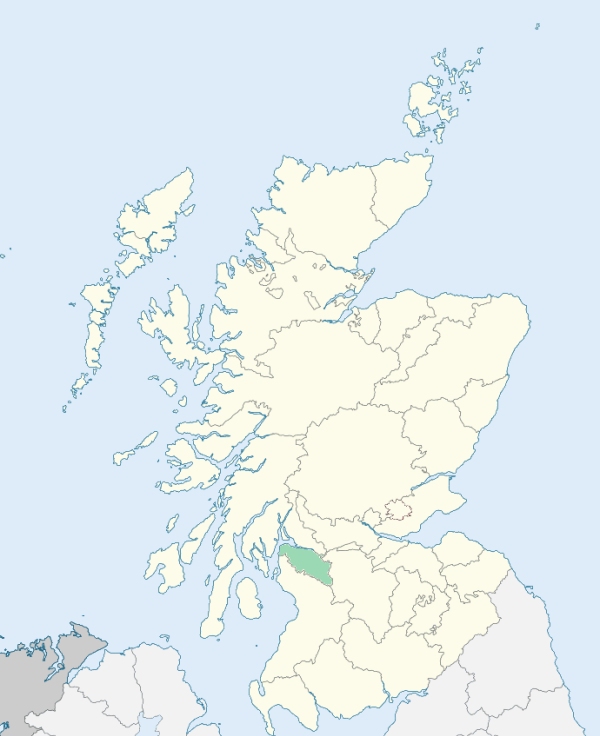
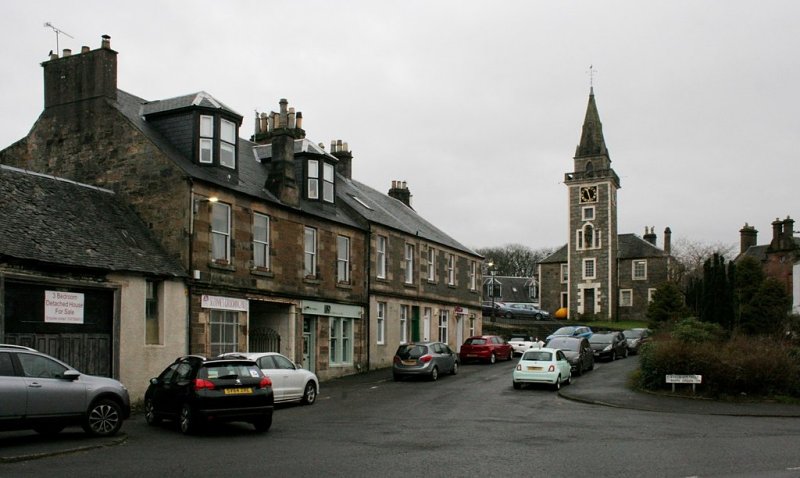
Kilbarchan is a parish in the centre of Renfrewshire. It is bounded by Houston, Erskine, Inchinnan, Renfrew, Abbey-Paisley, Lochwinnoch, and Kilmacolm. (1867: The Imperial Gazetteer of Scotland, by John Marius Wilson).
Balaklave, Blackstoun, Bridge of Weir, Kilbarchan, Linwood, Millikenpark
Craigends, Milliken
PRE-REFORMATION GOVERNANCE:
POST-REFORMATION GOVERNANCE:
The vicarage of Kilbarchan belonged to the Abbey of Paisley. Its church was dedicated to St Bearchan, and within it was an altar of St Mary. In the churchyard stood a chapel of St Katherine. At Kenmuir in the parish there was a chapel of St Bride, with St Bride's Burn running by. At Auchendinan on that burn was St Bride's Mill. In another part of the parish, at Ranfurlie, there was a chapel of St Mary, with the Priestoun beside it. St Bearchan's yearly fair is held at Kilbarchan in December.
Disjoined Quoad Sacra Parishes:
Bridge of Weir. The parish of Bridge of Weir was disjoined from Kilbarchan and Houston by the Court of Teinds, 14 March 1887.
Howwood. The General Assembly granted a constitution to a chapel here called Elliotstoun on 28 May 1838. It was rebuilt in 1858. The parish was disjoined from Lochwinnoch and Kilbarchan by the Court of Teinds, 15 July 1904.
Linwood. The parish was disjoined from Kilbarchan and the Abbey Parish of Paisley by the Court of Teinds on 19 January 1880.
St Andrew's, Johnstone. A chapel for the district of Laighcartside was built here in 1886. St Andrew's Parish was disjoined from Johnstone, Kilbarchan, and Elderslie, by decree of the Court of Teinds, 1 November 1901.
Includes ministers, licentiates, assistants, readers, and clerks.
Kilbarchan (QO)
Bridge of Weir (QS)
Howwood (QS)
Linwood (QS)
St Andrew's, Johnstone (QS)
(1928: Fasti Ecclesiæ Scoticanæ, by Hew Scott, D. D.)
Parish registers turned over to the Registrar-General, as a result of the Registration of Births, Deaths, and Marriages (Scotland) Act of 1854. The letters B. D. and M. indicate Births (or Baptisms), Deaths (or Burials), and Marriages (or Proclamations of Banns) respectively. Numbers indicate separate volumes or books. Note: These records are by no means complete or without damage; consult the Detailed List of the Old Parochial Registers of Scotland (1872) to learn more about the condition of the records.
| OPR and RD Numbers | |||
|---|---|---|---|
| Date Range | Name | Number | Type |
| 1649-1854 | Kilbarchan | 568 | OPR |
| 1855-1882 | Kilbarchan | 568 | RD |
| 1883-1963 | Kilbarchan | 568-1 | RD |
| 1883-1963 | Linwood | 568-2 | RD |
| 2009 | Renfrewshire, Johnstone | 644 | RD |
| 2026 | (Kilbarchan) Renfrewshire Council; Kilbarchan Community Council | ||
| 2026 | (Linwood) Renfrewshire Council; Linwood Community Council | ||
(2009: Parishes and Registration Districts of Scotland - Old and New, National Records of Scotland)
Local community councils (2026) are provided as a potential source of additional information for settlements within the original boundaries of the parish. (Source)
Statistics from informal and official censuses
Barr, Brown, Crawford, Gibson, Houston, Muir, Reid, Stevenson, Stewart, Wilson
Note: Names appearing in research materials, other than censuses. Simple names (First name, surname only) have been omitted unless they appear associated with large properties. All women's names, and men's names with occupations, military ranks, or peerage titles are included.
By the Reverend Mr Patrick Maxwell, Minister.
"As taken by actual survey in the year 1791 there were 171 families in the country, 391 families in the town; total 563 families. There were in the country 440 males and 482 females, of whom 194 were under age 10. In the town there were 762 males, 822 females, of whom 465 were under age ten. The total number of souls in the parish was 2506, viz. 1202 males, and 1304 females. Of these, 602 belong to the established church; there are about 30 Cameronians; all the rest are of the Burgher, or Relief persuasion.
All classes of people live better now than they did formerly. Oatmeal and potatoes make a great part of the food of the lower people. About 20 years ago, tea and butcher's meat were very seldom tasted by any of the lower ranks. Now they are more or less used by people of every description. The people are, in general, sober and industrious. If they indulge in any extravagance, it is chiefly in the article of dress; in this they are much more gay and splendid than formerly. At the same time, they are daily acquiring more politeness and urbanity of manners.
There have been no emigrations from the parish these 14 years; but this year, 1794, 3 families have emigrated to America, and many more are preparing to follow, from the fatal decay of trade, and want of employment."
(This section contains excerpts, at times restructured or paraphrased, from an article appearing in Statistical Account of Scotland, Sir John Sinclair, 1791-1799)
Primary Sources:
Statistical Account of Scotland (1791-1799), Volume 15, p. 482
New Statistical Account of Scotland (1834-1845), Volume 7, Section I, p. 352
See Parish Page Sources for all source information and links.