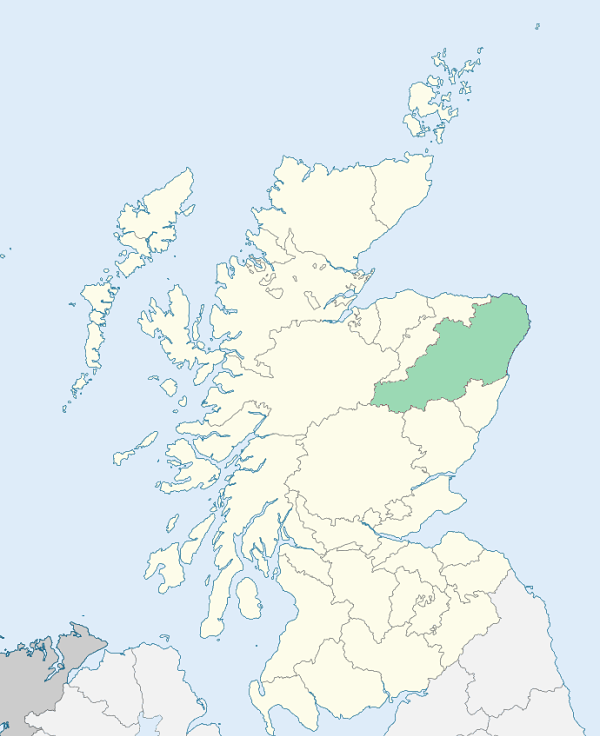
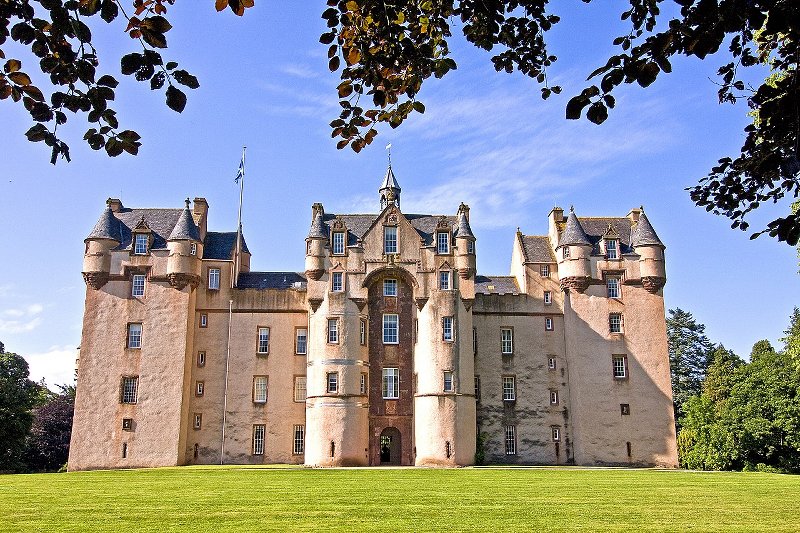
Fyvie is a parish in the Turriff district of Aberdeenshire. It is bounded by Turriff, Monquhitter, Methlick, Tarves, Old Meldrum, Daviot, Rayne, and Auchterless. (1867: The Imperial Gazetteer of Scotland, by John Marius Wilson).
Crichie, Fyvie, Gight, Millbrex, Monkshill, Woodhead
Kinbroon
PRE-REFORMATION GOVERNANCE:
POST-REFORMATION GOVERNANCE:
The church of Fyvie was dedicated to St Peter. It belonged to the Abbey of Arbroath. Fairs of St Peter and St Magdalene were held at Fyvie and also a tryst on Shrove Tuesday. Within the bounds there is a mission chapel of St Mary.
Disjoined Quoad Sacra Parishes:
Barthol Chapel. At the place now called Barthol Chapel there was of old a chapel of St Bartholomew belonging to the Abbey of Arbroath. Mary, Countess of Aberdeen, built a church here, which opened 16 August 1875, as a memorial of her son, George, 6th Earl of Aberdeen, he having been lost at sea in 1870. His brother and successor, John, the 7th Earl, afterward first Marquess of Aberdeen and Temair, gifted a manse to the Mission, and also contributed largely towards its endowment, with the result that the Parish of Barthol Chapel was disjoined from Tarves, Fyvie, Methlick, and Meldrum, on 17 January 1876.
Millbrex. A chapel was built at Millbrex in 1833. The parish was disjoined from Fyvie and Monquhitter, 14 July 1858.
Includes ministers, licentiates, assistants, readers, and clerks.
Fyvie (QO)
Barthol Chapel (QS)
Millbrex (QS)
(1928: Fasti Ecclesiæ Scoticanæ, by Hew Scott, D. D.)
Parish registers turned over to the Registrar-General, as a result of the Registration of Births, Deaths, and Marriages (Scotland) Act of 1854. The letters B. D. and M. indicate Births (or Baptisms), Deaths (or Burials), and Marriages (or Proclamations of Banns) respectively. Numbers indicate separate volumes or books. Note: These records are by no means complete or without damage; consult the Detailed List of the Old Parochial Registers of Scotland (1872) to learn more about the condition of the records.
| OPR and RD Numbers | |||
|---|---|---|---|
| Date Range | Name | Number | Type |
| 1684-1854 | Fyvie | 197 | OPR |
| 1855-1867 | Fyvie | 197 | RD |
| 2009 | Aberdeenshire, Turriff | 314 | RD |
| 2026 | Aberdeenshire Council; Fyvie, Rothienorman and Monquhitter Community Council | ||
(2009: Parishes and Registration Districts of Scotland - Old and New, National Records of Scotland)
Local community councils (2026) are provided as a potential source of additional information for settlements within the original boundaries of the parish. (Source)
Statistics from informal and official censuses
Beaton, Davidson, Duncan, Milne, Reid, Robertson, Smith, Strachan, Taylor, Wilson
Note: Names appearing in research materials, other than censuses. Simple names (First name, surname only) have been omitted unless they appear associated with large properties. All women's names, and men's names with occupations, military ranks, or peerage titles are included.
By the Reverend Mr William Moir.
"The number of souls at present in the parish is 2194, of which 1059 are males, 1135 females, 22 widowers, 74 widows; 300 Dissenters, of whom 3 are Roman Catholics, 12 Seceders, and the rest Nonjurors, who have 2 places of worship in the parish. There are 9 shoemakers, 10 weavers, 7 smiths, 10 tailors, 11 wrights, 2 dyers. There is also a midwife regularly bred to the business at the expense of the session.
The people are in general decent and well behaved; seldom frequenting the inn or tavern, but upon very particular occasions; generally sympathizing with those in distress, and ready to give them such assistance as they can afford. Their houses are in general more neat and comfortable than they were 30 years ago. Their dress and manner of living are also improved.
The manufacture in which the women are chiefly employed, is that of spinning wool, and knitting it into hose. Several of the men servants also employ themselves in the winter evenings, in knitting their own stockings. A much better way of employing their time than frequenting the ale-house, of which there are only 3 in the parish.
There are in the parish 13 corn-mills, in each of which there is a fanner and winnower, turned by the machinery of the mill, which not only facilitates the people's labour, but enables them to work in good and bad weather; 2 fulling-mills, a barley-mill, and a lint-mill, which was erected in 1782; before which time there was scarce any lint-seed sown in the parish; but now there are few farmers who do not sow some quantity."
(This section contains excerpts, at times restructured or paraphrased, from an article appearing in Statistical Account of Scotland, Sir John Sinclair, 1791-1799)
Primary Sources:
Statistical Account of Scotland (1791-1799), Volume 9, p. 459
New Statistical Account of Scotland (1834-1845), Volume 12, p. 315
See Parish Page Sources for all source information and links.