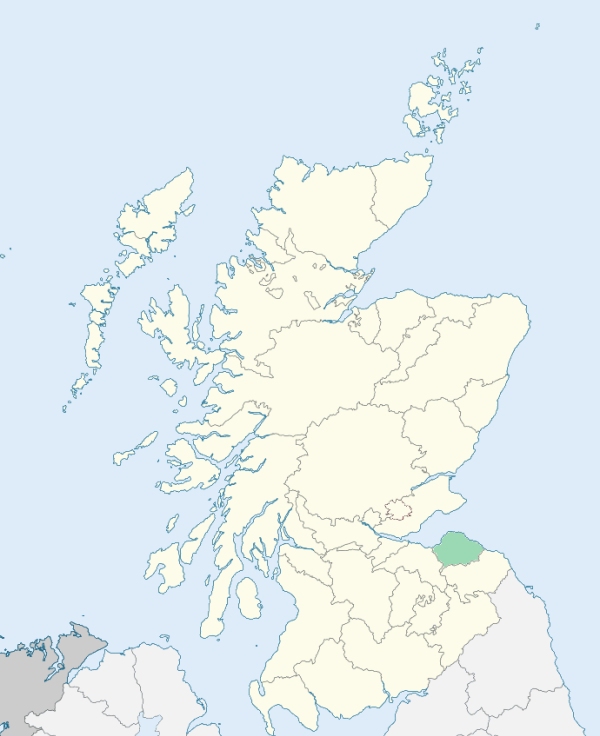
Pencaitland is a parish in the western division of Haddingtonshire. It is bounded by Gladsmuir, Salton, Ormiston, and Tranent. (1867: The Imperial Gazetteer of Scotland, by John Marius Wilson).
Easter Pencaitland, Newton, Pencaitland, Wester Pencaitland
Pencaitland
PRE-REFORMATION GOVERNANCE:
POST-REFORMATION GOVERNANCE:
Previous to the Reformation the church belonged to the Abbey of Dryburgh; disjoined from the Presbytery of Dalkeith between 30 March 1583 and 11 October 1587. Keith-Marishcal was in the charge till 1588.
Includes ministers, licentiates, assistants, readers, and clerks.
(1928: Fasti Ecclesiæ Scoticanæ, by Hew Scott, D. D.)
Parish registers turned over to the Registrar-General, as a result of the Registration of Births, Deaths, and Marriages (Scotland) Act of 1854. The letters B. D. and M. indicate Births (or Baptisms), Deaths (or Burials), and Marriages (or Proclamations of Banns) respectively. Numbers indicate separate volumes or books. Note: These records are by no means complete or without damage; consult the Detailed List of the Old Parochial Registers of Scotland (1872) to learn more about the condition of the records.
| OPR and RD Numbers | |||
|---|---|---|---|
| Date Range | Name | Number | Type |
| 1598-1854 | Pencaitland | 716 | OPR |
| 1855-1967 | Pencaitland | 716 | RD |
| 2009 | East Lothian, Tranent | 723 | RD |
| 2026 | East Lothian Council; Pencaitland Community Council | ||
(2009: Parishes and Registration Districts of Scotland - Old and New, National Records of Scotland)
Local community councils (2026) are provided as a potential source of additional information for settlements within the original boundaries of the parish. (Source)
Statistics from informal and official censuses
Anderson, Dodds, Duncan, Gray, Hamilton, Hogg, Scott, Smith, Thomson, Wood
Note: Names appearing in research materials, other than censuses. Simple names (First name, surname only) have been omitted unless they appear associated with large properties. All women's names, and men's names with occupations, military ranks, or peerage titles are included.
By the Reverend Mr Henry Sangster, Minister of Humbie.
"By an accurate enumeration, in July 1793, the number of souls in the parish was 1033. The number of souls in the villages, 512; in the country, 521. There are a very few sectaries, who have occasionally come into this from neighbouring districts.
There are 9 farmers, 4 masons, 4 carpenters, 110 colliers and their families, 2 shoemakers, 5 tailors, 9 weavers, 3 smiths, 1 dyer, 1 bleacher, 1 teacher, and 1 innkeeper. The other inhabitants are employed in the lime-works, and the different occupations of husbandry.
There are 4 villages, viz. Easter and Wester Pencaitlands, Winton, and Nisbet. In these all the trades people reside. In the village of Nisbet there are 2 weavers, who employ 8 looms for country work. They are the only weavers in the parish who are independent of the farmers, and consequently employ additional hands. The above 4 villages contain only 512 souls but it is better that this number should occupy 4 villages than one. There is one bleachfield, and there are 1 lint, 1 starch, 1 thread, 4 barley, and 4 corn mills. There are several threshing mills.
The people in general are satisfied with their condition, and are industrious. It is not remembered that an inhabitant of this parish has been punished by the civil magistrate for any crime. The mode of living has become more expensive than formerly among the farmers. The lowest class of people confine their taste and expense to their dress; and in this respect they are not behind others in the neighbouring districts."
(This section contains excerpts, at times restructured or paraphrased, from an article appearing in Statistical Account of Scotland, Sir John Sinclair, 1791-1799)
Primary Sources:
Statistical Account of Scotland (1791-1799), Volume 17, p. 33
New Statistical Account of Scotland (1834-1845), Volume 2, Section II, p. 344
See Parish Page Sources for all source information and links.