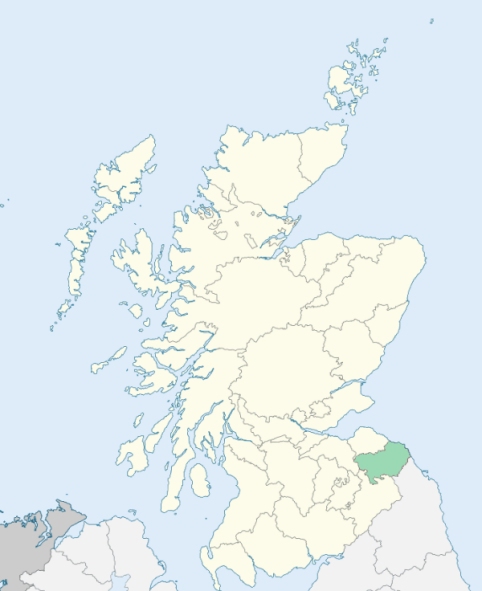
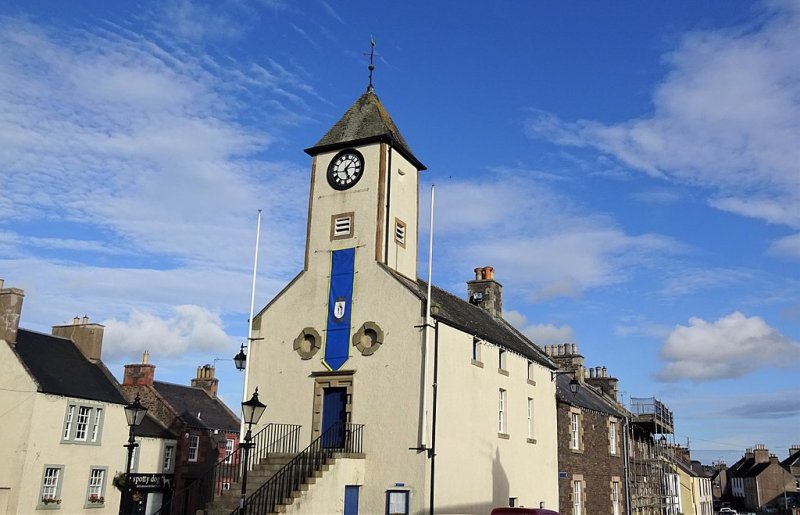
Lauder is a parish, consisting of a main body and a small detached section, in the district of Lauderdale, Berwickshire. The main body is bounded on the north by Haddingtonshire, on the east by the parishes of Longformacus, Cranshaws, Westruther, and Legerwood, on the south by Roxburghshire, and on the west by Edinburghshire, and by the parish of Channelkirk. The detached section lies 1½ miles south of the nearest part of the main body, is bounded partly by the parishes of Legerwood and Earlston, but principally by Roxburghshire. (1867: The Imperial Gazetteer of Scotland, by John Marius Wilson).
Addenston, Blyth, Boghall, Huntington, Lauder, Longhope, Lyleston, New Mills, Pilmuir, Thirlestane, Trabrown, Woodheads
The parish of Earlston had a small detached part which was also a detached part of the county of Berwick, and was surrounded by the county of Roxburgh. Within the county of Berwick the parish of Lauder had a detached part situated on the west of the Leader Water and projecting into the parish of Melrose and the county of Roxburgh. Two changes were made on the county boundary:
(a) the detached part of the parish of Lauder was transferred to the parish of Melrose, and at the same time to the county of Roxburgh;
(b) so much of Earlston parish as lay to the west of the Leader Water (including the detached part) was transferred to the parish of Melrose and to the county of Roxburgh.
See affected properties and landholders. (1892: Boundary of counties and parishes in Scotland as settled by the Boundary Commissioners under the Local Government Act, 1889, by Hay Shennan)
PRE-REFORMATION GOVERNANCE:
POST-REFORMATION GOVERNANCE:
The church, dedicated to St Mary, belonged to the Abbey of Dryburgh, as did also St Leonard's Hospital and the Chapel of Kedslie, both in the parish. At Thirlestane there was a priory of St Martin. In Lauder fairs were held on St Luke's and St Martin's Days.
Includes ministers, licentiates, assistants, readers, and clerks.
(1928: Fasti Ecclesiæ Scoticanæ, by Hew Scott, D. D.)
Parish registers turned over to the Registrar-General, as a result of the Registration of Births, Deaths, and Marriages (Scotland) Act of 1854. The letters B. D. and M. indicate Births (or Baptisms), Deaths (or Burials), and Marriages (or Proclamations of Banns) respectively. Numbers indicate separate volumes or books. Note: These records are by no means complete or without damage; consult the Detailed List of the Old Parochial Registers of Scotland (1872) to learn more about the condition of the records.
| OPR and RD Numbers | |||
|---|---|---|---|
| Date Range | Name | Number | Type |
| 1677-1854 | Lauder | 748 | OPR |
| 1855-1855 | Lauder Burgh | 748-1 | RD |
| 1855-1855 | Lauder Landward | 748-2 | RD |
| 1856-1971 | Lauder | 748 | RD |
| 1972-2006 | Lauder | 788 | RD |
| 2007-2009 | Scottish Borders, Lauder | 788 | RD |
| 2026 | Scottish Borders Council; Lauderdale Community Council | ||
(2009: Parishes and Registration Districts of Scotland - Old and New, National Records of Scotland)
Local community councils (2026) are provided as a potential source of additional information for settlements within the original boundaries of the parish. (Source)
Statistics from informal and official censuses
Brown, Hardie, Henderson, Laidlaw, Murray, Scott, Stewart, Thomson, Wilson, Wood
Note: Names appearing in research materials, other than censuses. Simple names (First name, surname only) have been omitted unless they appear associated with large properties. All women's names, and men's names with occupations, military ranks, or peerage titles are included.
By the Reverend Dr James Ford.
"There are at present about 2000 souls in the parish. 1500 of the inhabitants are above 10 years of age. About 1000 of these reside in the country part of the parish, and the remainder in the borough of Lauder. The people, in general, live long: Many have survived 90, and some even 100, during the incumbency of the present minister. Some are below middle stature, many above it; and the size of not a few is upwards of six feet. The people are, generally, strong and healthy.
There are about 40 farmers in the parish, and a considerable number of artists in the borough and country. There are two writers, and two surgeons. The people are generally active and spirited, and have always been ready to engage in labour of any kind: Many of them are, at present, both in the army and navy."
(This section contains excerpts, at times restructured or paraphrased, from an article appearing in Statistical Account of Scotland, Sir John Sinclair, 1791-1799)
Primary Sources:
Statistical Account of Scotland (1791-1799), Volume 1, p. 72
New Statistical Account of Scotland (1834-1845), Volume 2, Section III, p. 1
See Parish Page Sources for all source information and links.