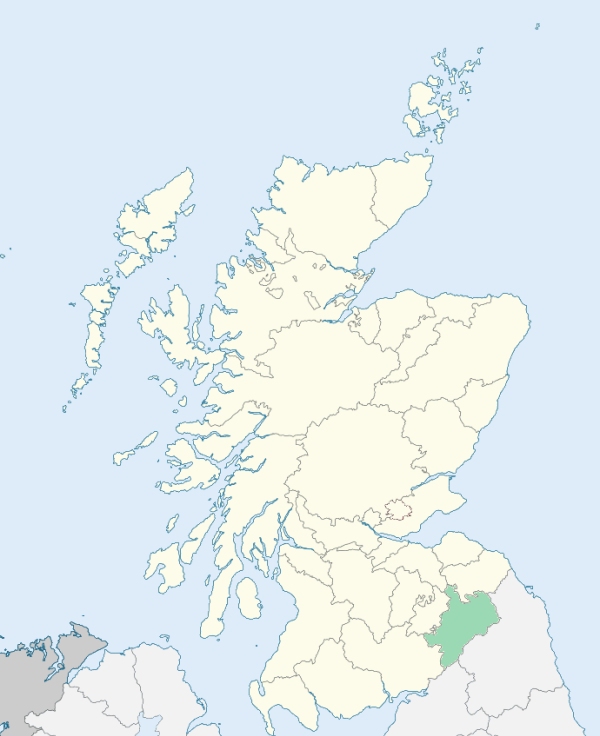
Kelso is a parish in the north-east of Roxburghshire. It is bounded by Nenthorn in Berwickshire, and by Stichel, Ednam, Sprouston, Eckford, Roxburgh, Makerston, and Smailholm. (1867: The Imperial Gazetteer of Scotland, by John Marius Wilson).
Kelso, Maxwellheugh
Springwood Park
PRE-REFORMATION GOVERNANCE:
POST-REFORMATION GOVERNANCE:
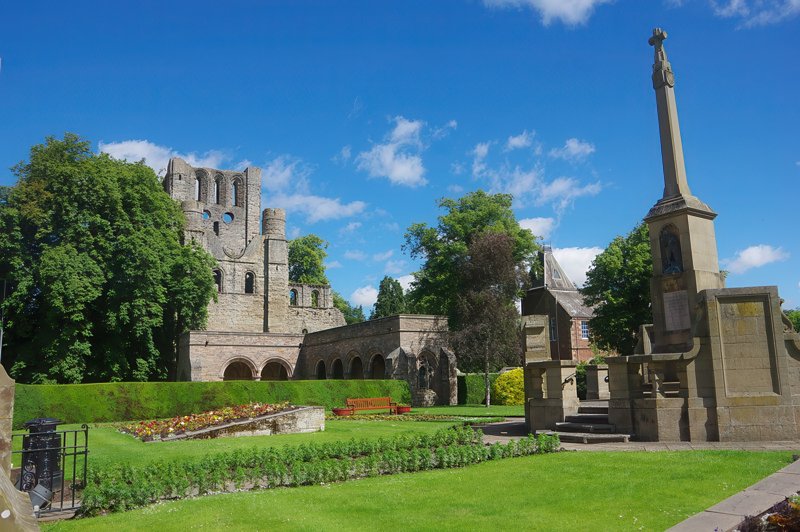
Kelso. The church was dedicated to St Mary. Prior to the Reformation it belonged to the Abbey of Kelso. About 1648, the abbey, which had suffered considerably at the hands of Hertford during his invasion of Scotland in 1545 [See: The Burning of Edinburgh at Wikipedia], was put into repair and fitted up as the parish church. It continued to be so used until 1773, when the present church was erected.
Maxwell. The church of Maxwell, dedicated to St Michael, was situated near the junction of Tweed and Teviot. At Harlaw, near the head of the Burn of Wooden in the parish of Maxwell, there was a chapel of St Thomas the Martyr. In 1180 this was given by Herbert of Maxwell to the parish church of Maxwell. Afterwards it passed into the hands of the Abbey of Kelso. The English destroyed it in 1545.
St James's, or New Roxburgh. This was the parish of the Royal Burgh of Roxburgh. The church was dedicated on 17 April 1134. It belonged to the Abbey of Kelso. The English ruined the church in 1425. The church was soon rebuilt, but was utterly destroyed, along with the towns of Roxburgh and Kelso, during the invasion of 1545. The hospital of Fairnington, with the parish of St James, is mentioned as early as 1186.
Disjoined Quoad Sacra Parishes:
North Parish. A church, built and endowed largely by James Nisbet, publisher, London (a native of Spylaw, Kelso), was opened on 26 November 1837. Disjoined from the parish of Kelso, and erected into a parish quoad sacra, 1868.
(1928: Fasti Ecclesiæ Scoticanæ, by Hew Scott, D. D.)
Includes ministers, licentiates, assistants, readers, and clerks.
Kelso, Maxwell, and St James's (QO)
North Parish (QS)
(1928: Fasti Ecclesiæ Scoticanæ, by Hew Scott, D. D.)
Parish registers turned over to the Registrar-General, as a result of the Registration of Births, Deaths, and Marriages (Scotland) Act of 1854. The letters B. D. and M. indicate Births (or Baptisms), Deaths (or Burials), and Marriages (or Proclamations of Banns) respectively. Numbers indicate separate volumes or books. Note: These records are by no means complete or without damage; consult the Detailed List of the Old Parochial Registers of Scotland (1872) to learn more about the condition of the records.
| OPR and RD Numbers | |||
|---|---|---|---|
| Date Range | Name | Number | Type |
| 1597-1854 | Kelso | 793 | OPR |
| 1855-1947 | 793 | RD | |
| 1948-1967 | Kelso and Smailholm | 793 | RD |
| 1968-1971 | Kelso | 793 | RD |
| 1972-2006 | Kelso | 821 | RD |
| 2007-2009 | Scottish Borders, Kelso | 821 | RD |
| 2026 | Scottish Borders Council; Kelso Community Council | ||
(2009: Parishes and Registration Districts of Scotland - Old and New, National Records of Scotland)
Local community councils (2026) are provided as a potential source of additional information for settlements within the original boundaries of the parish. (Source)
Statistics from informal and official censuses
Allan, Brown, Henderson, Robertson, Rutherford, Scott, Taylor, Trotter, Turnbull, Wilson
Note: Names appearing in research materials, other than censuses. Simple names (First name, surname only) have been omitted unless they appear associated with large properties. All women's names, and men's names with occupations, military ranks, or peerage titles are included.
By Dr Christopher Douglas, Physician in Kelso.
"In the year 1749, the number of inhabitants was 2900. The return from Dr Webster, in 1755, was 2781, and the number at present amounts to 4324. From an exact survey of the parish, made last year (1792), there were in the town 376 houses, 826 families, 1644 males, 1913 females, a total of 3557 souls, of whom 933 were under 10 years of age. In the country there were 126 houses, 127 families, 365 males, 402 females, a total of 767 souls, of whom 193 were under 10 years of age.
Besides the established church, and an Episcopal chapel, there are a number of sects, each of which has a house for public worship, and some of them are even elegant. These are the kirk of Relief, Burghers, Antiburghers, Cameronians, Methodists, and Quakers. There are three Roman Catholics, and one Jew in the parish. The major part of the inhabitants, particularly of the genteel class, attend the parish church, and Episcopal chapel.
In the parish there are 20 skinners, 60 weavers, 1 optician, 3 dyers and clothiers, 47 tailors, 2 upholsterers, 2 brewers, 6 plasterers, 60 carpenters, 6 midwives, 40 masons, 15 smiths, 6 copper and white iron smiths, 3 stay-makers, 2 house painters, 4 glovers, 3 carriers, 40 carters, 162 labourers, 7 clergymen, 6 medical practitioners, 11 writers or attorneys, 7 schoolmasters, 2 booksellers and printers, 30 shopkeepers, 32 bakers, 24 butchers, 40 inn and alehouse keepers, 12 saddlers, 147 shoemakers, 7 stocking weavers, 10 gardeners, 7 nailers, 3 cutlers, 4 watchmakers, 2 glaziers, 6 barbers and hair-dressers, 4 milliners, 8 mantua-makers, and 2 pastry cooks."
(This section contains excerpts, at times restructured or paraphrased, from an article appearing in Statistical Account of Scotland, Sir John Sinclair, 1791-1799)
Primary Sources:
Statistical Account of Scotland (1791-1799), Volume 10, p. 576
New Statistical Account of Scotland (1834-1845), Volume 3, Section I, p. 298
See Parish Page Sources for all source information and links.